Dr. Ayman Zahry
Population and Migration Studies Expert, Member of the Migration and Refugee Forum for the Arab World (MARFA)
When we contemplate the map of Cairo’s informal and working-class neighborhoods, the dominant explanation tends to attribute their emergence to poverty, rural-to-urban migration, or demographic pressure. Yet some neighborhoods cannot be understood through such simplification. They were not born solely from the social margins, but from another, less visible margin: the state’s own functional margins. Among the most striking of these cases is the story of the Sudanese Camel Corps soldiers who settled in Ain Shams, one of the most telling narratives of the complex relationship between the military institution, migration, and urban settlement.
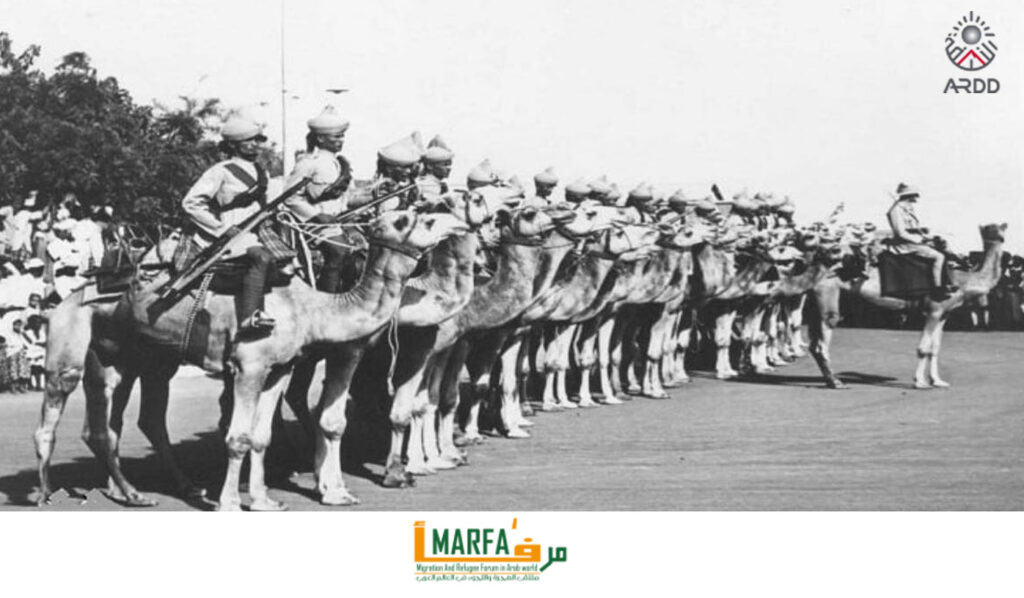
The Camel Corps were semi-regular military unit that relied on riding camels. They were tasked with securing borders, guarding desert roads, and maintaining security in remote areas. Sudanese soldiers formed the backbone of these forces, drawing on their environmental knowledge, their ability to adapt to desert conditions, and a long history of Sudanese involvement in the Egyptian army. During the early decades of the twentieth century, these units were an essential part of the state’s tools for extending its influence beyond cities, at a time when the civilian bureaucracy had not yet fully matured.
At the beginning of the twentieth century, Ain Shams was not the densely populated residential district we know today. Rather, it was a peripheral, semi-desert area on the edge of Cairo. This location made it suitable for establishing military camps: far from residential clusters, yet close to desert movement routes. There, the state set up camps for the Camel Corps as a temporary functional deployment—not as a permanent urban development project. But the city, by its nature, does not always abide by what is temporary.
The paradox begins with the end of military service. Between the 1920s and 1930s, the importance of Camel Corps units declined as border-control patterns changed and transportation developed. The missions of some camps ended, without any clear policies accompanying this shift to return soldiers to their original homelands. Many Sudanese soldiers found themselves in an ambiguous position: no longer active soldiers, not returning home, and with no official mechanism to integrate or resettle them. At this moment, the silent transformation began: the camp became a home, temporary residence became permanent, and the soldier became a civilian worker, without announcement or administrative decision.
Over the following decades of the twentieth century, some of the Camel Corps men married Egyptian women or Sudanese women residing in Cairo. Networks of kinship and work emerged, and the residential areas around the former camps expanded. Gradually, an informal residential cluster took shape, popularly known as “Al-Haggana” (the Camel Corps). This neighborhood did not arise from an urban plan, nor was it officially recognized in its early stages, but it became rooted in the land through human accumulation and endured out of necessity.
The neighborhood, especially in its early stages, retained certain Sudanese cultural features: in physical appearance, in some social customs, in music and celebrations, and in a hybrid dialect combining Sudanese and Egyptian speech. Yet this distinctiveness did not become institutional recognition; it remained present as a form of “difference” within the margins. The residents were not viewed as a group with a specific history, but rather as part of the informal settlements—stripped of their social and military context.
The story of the Camel Corps in Ain Shams reveals a truth often overlooked in public debate: the state is not always a victim of informal settlements; it may also be one of their makers. When the state uses a human force for a long period and then abandons it without a post-service vision, it leaves a vacuum that can only be filled by informal settlement. In this case, the neighborhood is not the result of rebellion against the state, but a direct outcome of its neglect.
This story illustrates a different trajectory of migration and settlement. The Camel Corps did not come to Cairo in search of work; they arrived through the military institution. Soldiering here is not merely a job, but a channel of resettlement, even if it was not designed that way. This pattern differs from traditional rural-to-urban migration: it began with a clear legal status, continued through long-term residence, and ended in an ambiguous legal and social condition.
This story matters today because many discussions about popular neighborhoods treat them only as a present-day problem, detached from their roots. Yet the case of the Camel Corps shows that some neighborhoods are living archives of old decisions, and that understanding today’s urban reality requires returning to the state’s own social history. Place is not merely a built form, but an accumulation of policies, functions, and lives whose official roles ended while their human traces remained.
The story of the Sudanese Camel Corps in Ain Shams is not merely the story of a neighborhood. It is a reminder that a city is not built only by maps and decisions, but also by soldiers whose service ended while their lives did not, and by a state that knew how to use them, but did not know how to reintegrate them.
Perhaps this short article will inspire a graduate student in sociology, anthropology, history, political science, or even urban planning to conduct a deeper study of this important subject, one that has not received sufficient attention from rigorous academic research.