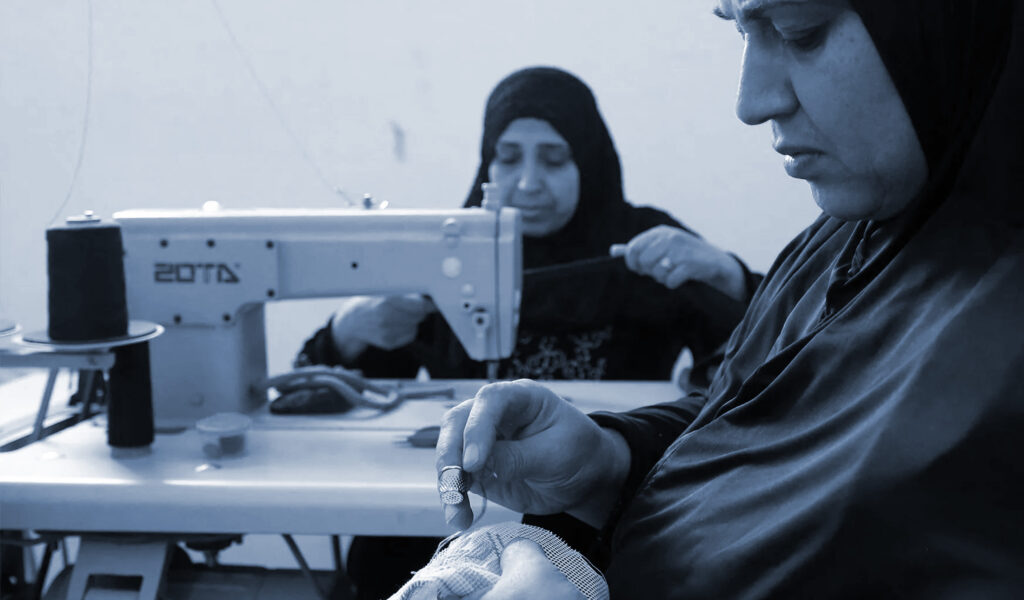
In public debates on pension systems in the Arab region, the issue is often framed primarily in terms of financial sustainability: fund deficits, rising life expectancy, and growing pressure on public expenditure. Yet, important as this perspective may be, it often overlooks a deeper question linked to social justice between women and men: do current pension designs truly reflect the realities of women’s lives, and their professional and social trajectories?
Proposing the option for women to retire at age 55 should not be understood as a call for women to withdraw from the labour market. Rather, it is an approach that recognises the structural differences between men’s and women’s life paths, and the accumulated, often invisible burdens women carry over decades.
Research literature in occupational health, economic sociology, and social protection policy suggests that making retirement at age 55, or flexible retirement starting from that age, an available option for women rather than a mandatory rule, can be part of a fairer and more life-course-sensitive design. This argument is grounded in a set of interconnected considerations:
- A health and psychological consideration: reducing chronic stress and cumulative exhaustion after decades of combining paid work with unpaid care responsibilities, which can improve quality of life and support preventive health in midlife.
- An economic and professional consideration: enabling a gradual transition from full-time employment to more flexible and productive forms of work suited to this stage (consulting, community work, small entrepreneurship), rather than an abrupt exit from the public sphere.
- A family and care consideration: supporting women’s ability to provide care for ageing parents or family members whose needs often increase at this stage, without care becoming a politically or economically unrecognised burden.
- A labour market consideration: contributing to the redistribution of opportunities in labour markets facing high youth unemployment, through gradual solutions such as partial retirement or reduced working hours, rather than a zero-sum trade-off between generations.
To understand these considerations within a coherent explanatory framework, the literature draws on several theoretical approaches that help interpret “early retirement” as a life-course transition rather than a withdrawal from productivity. Among the most prominent are the following.
First: The Life Course Perspective, Reading Invisible Accumulation
Life Course Theory emphasises that major decisions in midlife are not isolated from the historical and social context that preceded them. In the Arab region, women often begin their professional lives under strong family expectations, then enter motherhood and caregiving stages without a fair redistribution of roles within the household.
International Labour Organization data show that women perform three times as much unpaid work as men, including childcare, care for elderly parents, and household management. This invisible labour is not counted in GDP calculations, nor is it recognised in pensionable years of service. Yet it steadily depletes women’s physical and psychological capital.
By the time women reach their mid-fifties, they have not only completed “30 years of work,” but 30 years of double work.
Second: Midlife Health, a Neglected Dimension in Public Policy
Age 55 roughly coincides with a significant biological transition in women’s lives: the period before and after menopause. World Health Organization reports indicate that this phase may be associated with higher rates of anxiety and sleep disorders, as well as increased risks of heart disease under chronic stress.
Occupational health studies also show that long-term exposure to work-related stress increases the likelihood of burnout and depression, particularly among women who carry additional caregiving responsibilities.
In this context, reducing work-related pressure at this stage should not be treated as a luxury, but as an investment in public health and a way to reduce the costs of treatment and healthcare later in life.
Third: Redefining Productivity, From Employment to Purpose
Socioemotional Selectivity Theory (Laura Carstensen) explains that as individuals age, they tend to reorder priorities, shifting from long-term institutional achievement toward meaning, relationships, and quality of life.
This shift does not mean lower productivity; rather, it reflects a change in its form. Many women at this stage move into advisory roles, volunteering, community engagement, or establish small initiatives grounded in accumulated experience.
Accordingly, retirement at 55 should not be understood as an exit from the public sphere, but as a transformation in the nature of participation.
Fourth: Social Justice Between Women and Men and Social Security Systems
Pension systems in most Arab countries were historically designed around the “male breadwinner” model, assuming continuous and uninterrupted career paths. Women’s trajectories, however, often include periods of interruption due to motherhood or caregiving.
As a result, many women receive lower pensions despite their greater overall social contribution. From the perspective of social justice between women and men, it becomes legitimate to consider policies that recognise this structural gap, such as:
- Counting care periods within years of service.
• Allowing flexible retirement without harsh penalties.
• Providing professional transition programmes after age 55.
Fifth: The Macroeconomic Dimension, Between Sustainability and Flexibility
The financial dimension cannot be ignored. Social security funds in a number of Arab countries face real sustainability challenges. However, the solution does not lie in raising retirement ages uniformly without accounting for differences between women and men.
A more balanced approach includes:
- Adopting partial retirement models.
• Allowing reduced working hours before full retirement.
• Providing incentives for voluntary retirement savings for women from an early age.
In this way, financial sustainability can be protected while respecting the specificity of women’s labour market trajectories.
Sixth: From Protection to Empowerment
At its core, this debate is not about exempting women from work, but about empowering them to choose the timing and form of their transition from formal employment to a more flexible stage of life.
Policies that are attentive to differences between women and men are not an emotionally driven form of positive discrimination. They are, rather, a correction to historical imbalances in the design of economic systems. When the state grants women the option to retire at 55 within a safe and sustainable framework, it does not diminish women’s productive value. It recognises that economic dignity includes the right to manage one’s personal time after decades of compounded contribution.
Early retirement for women at age 55 is not a ready-made formula, nor should it be imposed as a universal model. However, it deserves to be discussed as a legitimate policy option within a broader reform package that strengthens social justice between women and men, public health, and family stability.
The real question is not:
“Should women retire early?”
But rather:
“Were our economic systems designed in the first place to take women’s life paths into account as they actually are, rather than as we imagine them to be?”
Challenges in the Arab Context
- Weak social protection systems in some countries.
- Persistent gender wage gaps.
- Fragile or absent retirement savings plans sufficient for women.
- Social pressure that ties women’s value to continuous giving and care.
Policy Recommendations for Arab Governments
- Adopt flexible retirement models (Flexible Retirement).
Allow gradual retirement options between ages 55 and 60, with proportional pension adjustments, rather than banning early retirement altogether. - Count caregiving years as part of service.
Integrate unpaid care periods into social security calculations, as some European countries do. - Professional transition programmes after 55.
Establish retraining and transition programmes toward consulting, community governance, or small entrepreneurship. - Health incentives.
Integrate preventive health programmes for midlife women into social security policies. - Early financial empowerment.
Strengthen voluntary retirement savings programmes for women from an early age to prevent income vulnerability later.
Financial Considerations
Any reduction or increase in retirement age should be balanced against:
- The sustainability of social security funds.
• The demographic age structure of each country.
• Actual rates of women’s participation in the labour market.
Therefore, the solution is not to impose mandatory early retirement, but to provide a well-designed option grounded in social justice between women and men and public health.