By Malak Suleiman
Over the past two decades, Jordan and the wider Arab region have witnessed a notable expansion in programs aimed at developing women’s leadership. Governments, donors, and civil society organizations have invested substantial resources in training, capacity-building, and promoting women’s civic and political participation.
The experience of the Arab Renaissance for Democracy and Development (ARDD) provides a clear example of these efforts. Through programs such as “She Leads,” “Nidaa’ for Change,” “Empowering Each Other,” in its different phases and “GenG – A New Generation,” in addition to the Arab Women Leadership Academy among other programs throughout the years, hundreds to thousands of women and girls have been trained in leadership, advocacy, and public engagement. These programs have also been accompanied by research and policy efforts aimed at understanding the barriers that women face in accessing decision-making positions.
Yet the reality indicates that women’s representation in leadership remains below expectations. These programs, alongside many national and international initiatives, reveal an important truth: the challenge is no longer a lack of training or the absence of qualified women, but rather a gap between investments in capacity-building and the ability of institutional environments to absorb and utilize these capacities.
In Jordan, despite high levels of educational attainment among women, the proportion of women in senior executive positions in companies does not exceed 3.1%, a figure that reflects deeper structural imbalances in pathways to leadership.
Today, the Arab landscape faces a challenge that goes beyond simply facilitating access to positions of power; it extends to redefining leadership itself. This raises an important question: Do the prevailing leadership structures in our societies possess the flexibility needed to accommodate the innovative approaches that women bring? And should the role of civil society remain limited to training, or does the responsibility also lie with the state, across its institutions, to translate these capacities into reality through enabling legislation and national policies?
Beyond the Numbers: Diagnosing Complex Barriers
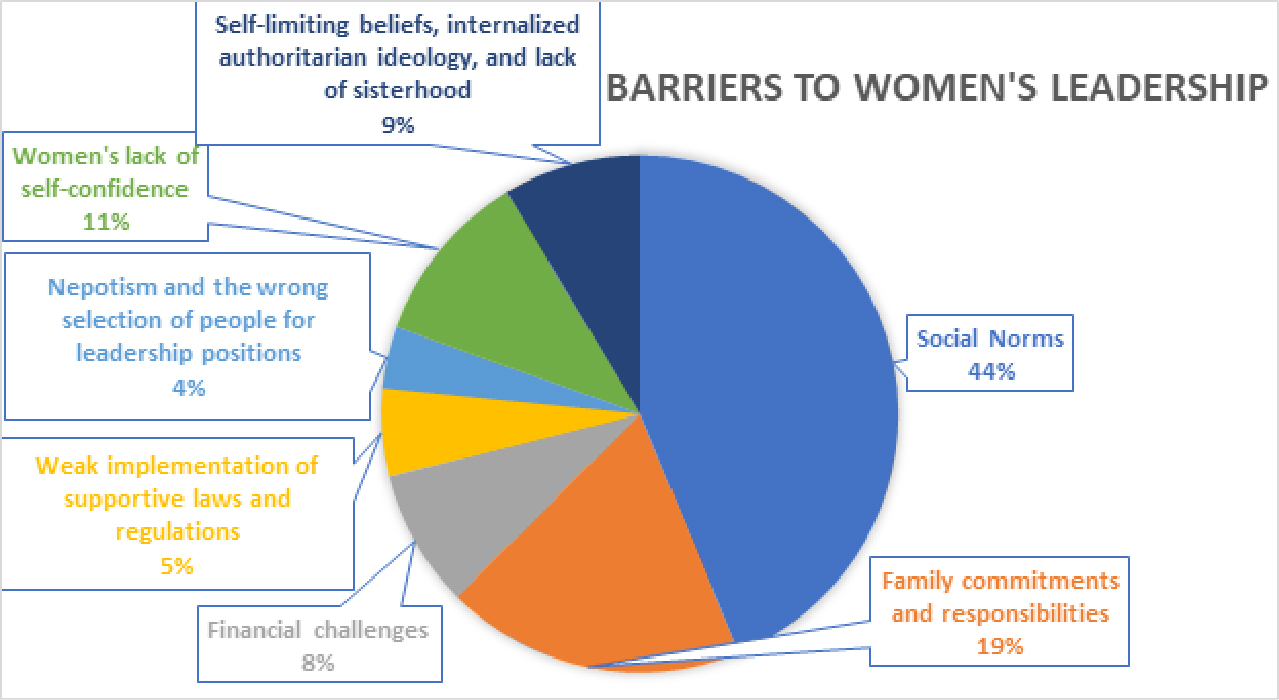
Field experience and recent studies including Women’s Leadership Needs Assessment (2023–2024) conducted by ARDD with 123 Jordanian women from diverse governorates and backgrounds reveal that the barriers women face in reaching leadership positions are multifaceted, combining structural, personal, social, and behavioral dimensions. These challenges manifest primarily as follows:
Even when structural barriers preventing women from reaching decision-making positions are overcome, and despite the emergence of inspiring female leaders who have achieved remarkable success across various sectors, we still encounter a more complex reality. Many institutions continue to operate according to traditional leadership models historically designed within authoritarian environments. At the same time, persistent social stereotypes continue to shape perceptions of women’s suitability for leadership roles.
The paradox becomes even more complex when women actually reach leadership positions. Many female leaders find themselves deprived of the freedom to adopt leadership styles aligned with their own convictions or goals. Here, a hidden dimension of women’s leadership emerges: the internalization of subjugation, whereby psychological and institutional pressures push women to adopt stereotypically authoritarian leadership styles characterized by rigidity, an unspoken condition for gaining legitimacy and proving competence within systems originally designed around a single dominant model.
This reveals a fundamental flaw in the broader discussion on women’s leadership. Instead of repeatedly asking “Why don’t women reach leadership positions?”, the more accurate question may be:
“Have our leadership systems been designed in a way that actually allows women to lead?”
A Conceptual Shift: From Control to Ethical Influence
Practical experience in women’s leadership programs suggests that women often bring leadership models that differ from traditional ones. In community and humanitarian work, women tend to favor participatory leadership, grounded in ethical leadership, trust-building, collective action, accountability, and linking leadership to values of justice and public service.
This is reflected in practice, from municipalities to refugee camps, where women transform leadership from an individual climb to the top into a collective effort to create sustainable impact.
This shift aligns with contemporary leadership studies, which no longer view leadership merely as an individual’s ability to control, but rather as a relational and participatory process built on ethical influence.
The real challenge, therefore, is not to train women to resemble traditional leadership models, but to develop institutional environments that allow more diverse and inclusive leadership models to emerge.
We Do Not Want a Seat… We Want a New Table
Today, the debate on women’s leadership is no longer about the number of women in decision-making positions alone; it is about the nature of the leadership system itself. The issue is no longer simply about finding women a seat at the table, but about redesigning the table itself so that it becomes more inclusive, more just, and more capable of harnessing the diverse talents within society.
For this new table to become possible, it must rest on four interconnected pillars that form the enabling environment for women’s leadership.
The first pillar is continued investment in women’s leadership capacities. Qualified women already exist, in universities, public and private institutions, and community work. However, transforming these capacities into influential leadership requires sustainable training programs, real opportunities for leadership experience, and clear pathways for professional and political advancement.
The second pillar is building supportive social and family environments. Women’s leadership does not flourish in hesitant or restrictive societies, but in communities that view women’s leadership as an added value for development and stability. Challenging stereotypes about women’s roles is therefore essential.
The third pillar is developing enabling legal and institutional frameworks that ensure equal opportunities and foster fair and inclusive workplaces. Policies that support work–life balance and encourage women’s participation in decision-making positions are crucial for moving empowerment from rhetoric to practice.
The fourth pillar is strengthening partnerships between government and civil society organizations. While government sets policies and legal frameworks, civil society contributes to capacity-building, expanding spaces for participation, and developing new leadership models. When these efforts converge within a clear national vision, as reflected in the Royal directives, women empowerment becomes an integral part of broader reform and modernization efforts. Jordan’s experience has demonstrated that such synergy can achieve significant progress, particularly when combined with investments in education, legislative reform, and expanded civic participation.
Ultimately, redesigning the “leadership table” is not simply about increasing the number of women around it. It is about building a leadership system that is more inclusive, more equitable, and more capable of harnessing the full potential of society. Qualified women exist, political will is present, and civil society possesses deep accumulated experience. What the coming phase requires is completing the construction of an enabling environment for leadership, so that women’s participation in decision-making becomes a natural reflection of society’s potential and aspirations for the future.