by Rand Azem
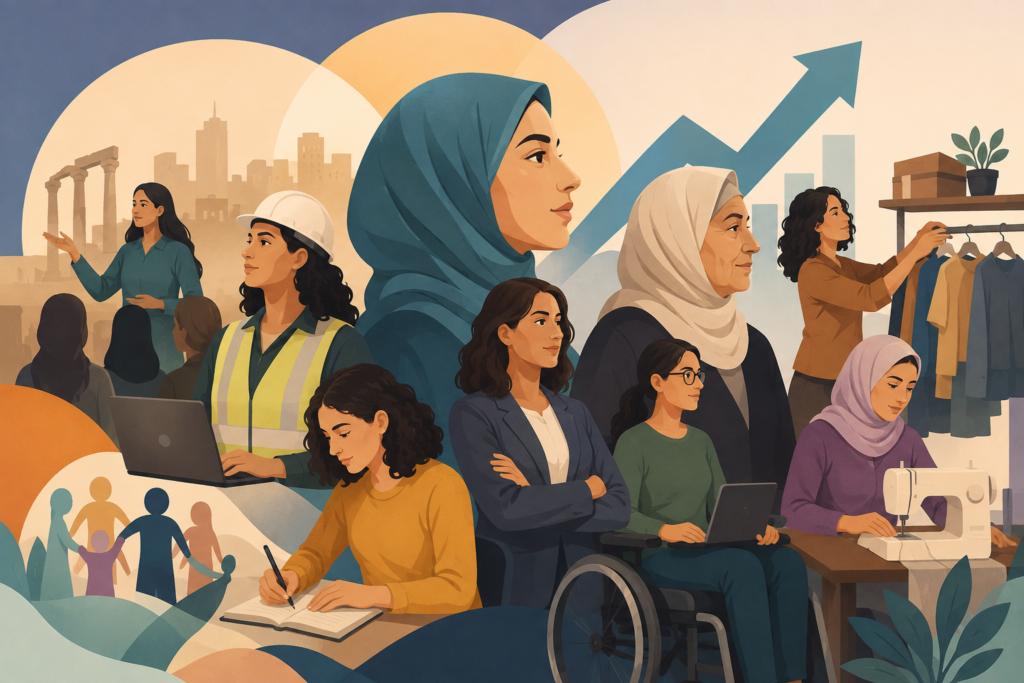
Peace in cities cannot be reduced to the mere absence of conflict. It is also reflected in the ability of residents, especially women, to move freely, access services, and participate in public life with safety and dignity. From this perspective, urban planning can be understood as a practical entry point closely linked to the Women, Peace and Security (WPS 1325) agenda, as it serves as a tool for translating this agenda from an international normative framework into a tangible, everyday practice within urban spaces. This approach helps operationalize the principles of UN Security Council Resolution 1325, adopted on 31 October 2000, which affirmed that sustainable peace cannot be achieved without the meaningful and equal participation of women in peace processes, extending beyond the political level to the social structures and routines of daily life.
Reports by the United Nations Development Programme (UNDP) confirm that cities designed with a gender, sensitive approach are better equipped to support women’s safe and sustainable participation, enhance their access to education, employment, and services, and thereby strengthen social cohesion and urban peace.
Urban Planning and the Pillars of the Women, Peace and Security Agenda
From a WPS perspective, urban planning directly affects its four pillars: protection, prevention, participation, and relief and recovery.
At the level of protection, urban planning elements, such as the quality of lighting, street design, the distribution of public facilities, and the availability of safe transportation, play a critical role in reducing the risks of harassment and violence against women. However, physical infrastructure must be coupled with social agency; this underscores the importance of strengthening and activating the role of civil society organizations in providing specialized training and awareness on protection strategies, particularly within public transportation systems.
In terms of prevention, preventive planning creates safe and active public spaces, while respecting the city’s specific context. As a vital preventive precaution, it is essential to build the capacity of both public transportation drivers and passengers regarding protection strategies and the appropriate response to Gender-Based Violence (GBV). By ensuring accessibility, mixed-use design, and a socially aware transit environment, these interventions address the root causes of violence before it occurs. This dual approach generates deeper, more sustainable outcomes that are directly aligned with the goals of the WPS agenda, ensuring that the city’s design and its people work in tandem to foster safety.
Participation is directly undermined when women are excluded from decision-making processes within municipalities and urban planning committees, resulting in urban policies that fail to reflect women’s lived experiences and daily needs. Conversely, involving women in participatory planning strengthens their right to the city and transforms public space from a potential site of exclusion into one of empowerment and active citizenship. relief and recovery, particularly in contexts of crisis and displacement, urban planning becomes essential for rebuilding social cohesion and ensuring women’s access to safe housing, essential services, and employment opportunities—thereby supporting fair and sustainable recovery.
Amman: Positive Steps Toward a More Inclusive City
Despite the urban challenges facing Amman, the city has witnessed several initiatives in recent years that signal a growing commitment to improving the quality of public space and making it more inclusive and safer for women. Public transportation projects, most notably the Bus Rapid Transit (BRT) system have facilitated women’s mobility across the city and expanded access to work, education, and services, which is a key factor in enhancing women’s economic and social participation.
At the same time, there remains a need to further develop these projects within a more comprehensive framework grounded in the principles of the Women, Peace and Security agenda. This includes reconsidering the design of certain stations, improving lighting in surrounding areas, and addressing harassment through institutional measures, to maximize their impact as tools for protection and prevention.
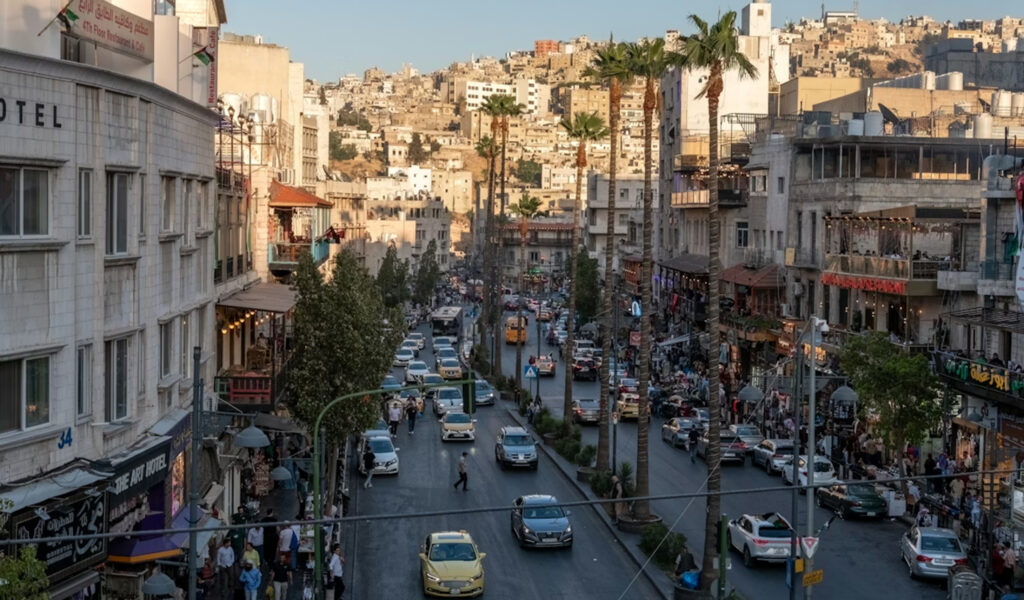
Similarly, the development of several public spaces such as Downtown Amman and Rainbow Street along with the opening of walking and recreational routes like the Al Steen Street promenade, has created more vibrant urban environments used for cultural and community activities and has encouraged greater female presence in public space. Such open and diverse spaces enhance social safety by increasing everyday use of the city and reinforcing the idea of the street as a shared space for all.
In addition, some neighborhoods in Amman have seen improvements to sidewalks and pedestrian routes, particularly near schools and service centers. While these interventions remain partial, they represent important steps toward a more walkable city that is more responsive to the needs of women, older persons, and persons with disabilities.
From Projects to Vision: Rethinking Urban Planning in Amman
Over the past three decades, Amman’s urban discourse has undergone noticeable shifts. Between 1990 and 2010, the Greater Amman Municipality focused primarily on large-scale infrastructure projects and the development of public squares and parks. Despite the continued scarcity of green and open spaces today, local initiatives such as Umm Al-Summaq Al-Sharqi Park stand out as examples that could be further developed into active community spaces that go beyond recreation to foster social cohesion and grassroots peacebuilding aligned with the WPS agenda’s emphasis on public space as a site of prevention and participation.
ARDD’s Role in Localizing the Women, Peace, and Security Agenda
Within the framework of localizing the Women, Peace, and Security (WPS) agenda, ARDD has played a significant role in broadening conventional understandings of peace and security by moving beyond conflict-centric interpretations toward the everyday, lived realities of women. This approach reframes peace and security as issues embedded in daily urban life, closely tied to access to public space, mobility, and social justice rather than being confined solely to contexts of armed conflict. Through its research and community-based initiatives, the organization has emphasized the civil and social dimensions of security, highlighting how women’s experiences within the city serve as a critical lens for evaluating inclusivity and equity in public policy.
In this context, initiatives such as Amaani and Tawasol have contributed to the localization of UN Security Council Resolution 1325 at the community level by strengthening women’s participation in discussions of community safety, crisis response, and social cohesion. These efforts underscore the importance of recognizing security as a socially produced condition shaped by everyday interactions with institutions, spaces, and urban structures. Importantly, this perspective situates public spaces as key arenas where inequalities and power relations are both reproduced and contested. Building on this conceptualization of security as an urban experience, ARDD has played a pivotal role in launching the ‘Future of Jabal Amman Committee.’ By applying a lens of inclusive governance to the area’s revitalization, the committee has translated the principles of the WPS agenda into a sustainable, heritage-driven urban plan. By centering the voices of women, youth, and marginalized communities in the design of tourism infrastructure and economic growth, the committee ensures that urban development remains equitable and culturally authentic. Through these strategic, multi-stakeholder partnerships, the committee seeks to transform the neighborhood into an inclusive hub where historical preservation and modern development serve to empower all residents and enhance local livelihoods.
This commitment to inclusive urban environments is further operationalized through ARDD’s work under the EU-funded CLOSER project. By championing participatory governance, ARDD will work on an innovative framework necessary to turn these social rights into a lived reality. The project facilitates a bottom-up co-design process, connecting public authorities, private actors, and civil society to jointly design social services that are more responsive to the specific needs of women and marginalized populations. In this model, governance is not merely a technical exercise but a collaborative effort that fosters a higher sense of co-responsibility and ownership over urban spaces. This orientation also intersects with broader debates on urban planning, where planning is understood not merely as a technical or spatial exercise but as a process with profound social and political implications. By foregrounding gender-sensitive perspectives, urban planning becomes integral to the realization of sustainable peace, as it directly influences patterns of access, visibility, and belonging within the urban environment. In this sense, the localization of the WPS agenda is closely linked to questions of spatial justice, demonstrating how the design and governance of cities can either reinforce exclusion or foster more inclusive and equitable forms of everyday security for women.
Toward an Inclusive Urban Renaissance
These experiences demonstrate that Amman has the potential to evolve into a more just and safer city if existing initiatives are built upon within a comprehensive urban vision that integrates a gender perspective and systematically involves women in planning and decision-making processes. A city that invests in its public spaces and in women’s right to use them safely and with dignity lays the foundations for peace in the details of everyday life. Peace that begins in the neighborhood is lived in the street, and is realized through participation and justice.