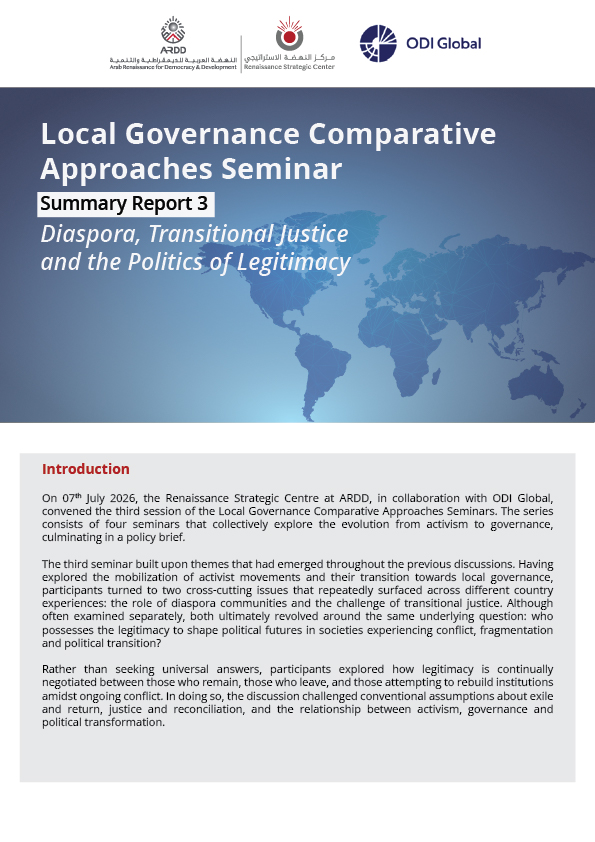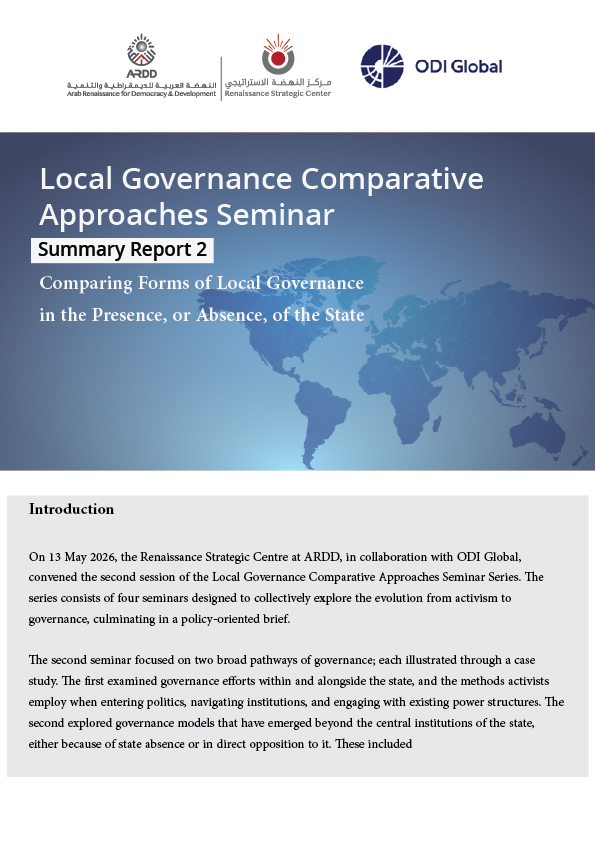

Local Governance Comparative Approaches Seminars
Organized by the Renaissance Strategic Center at ARDD, in collaboration with the Overseas Development Institute
March – August 2026
Concept Note
Governance Is Fragmenting – But It Is Also Being Rebuilt
Nearly half of those living in fragile and conflict-affected states now reside in areas where central authority has collapsed, receded, or is contested (Chatham House–NYU CIC, 2023). Structural weakness (DRC, Haiti, Mali, South Sudan), state implosion (CAR, Libya, Somalia, Yemen, parts of Syria), political miscalculation (Myanmar), and hybrid fragmentation are no longer exceptional; they are increasingly the norm.
In these contexts, national institutions struggle to deliver security, services, or legitimacy. Public trust erodes. International systems remain largely configured to engage central governments, even where those governments no longer meaningfully govern.
Yet governance has not disappeared. It has relocated.
Across fragile environments, communities – often led by youth – are constructing practical, participatory governance from below: delivering health care, education, civil protection, dispute resolution, and accountability mechanisms under conditions of extreme constraint.
The policy question is no longer whether this shift is occurring. It is whether international actors will adapt to it.
A New Generation of Governance Actors
Across diverse contexts, emerging local governance actors share consistent characteristics:
- Locally legitimate: authority grounded in community trust, not elite patronage.
- Service-oriented: prioritizing delivery over ideology.
- Participatory: favoring horizontal leadership and civic inclusion.
- Transnationally connected: learning across borders through activist networks.
The systems emerging differ in form but converge around a core reality: communities are rebuilding governance capacity faster than international frameworks are adapting to support them.
The Initiative
The Local Governance Comparative Approaches Seminars propose four closed, sequential virtual sessions bringing together activists and governance practitioners from Madagascar, Nepal, Sudan, South Africa, Zambia, Kenya, Sri Lanka, Myanmar, Syria, Libya, Yemen, Iraq and Iran.
Objectives
- Generate comparative insight into post-Arab Spring activism and its evolution.
- Document practical governance models emerging under fragmentation.
- Inform international policy adaptation to decentralized realities.
Session Themes
Three virtual and closed seminars will be organized under the leadership of the Renaissance Strategic Center (RSC), a Jordan-based think tank of the Arab Renaissance for Democracy and Development (ARDD). A period of one and a half months will be allocated between seminars in order to have sufficient time to prepare policy-type briefs that will not only summarize the issues discussed but also develop those that were insufficiently addressed. The London-based think-tank Overseas Development Institute (ODI) will take the lead in preparing a paper after the third session, bringing together ideas in preparation for the final seminar. The time period allocated for the preparation of the papers will allow the participants in the different sessions to contribute to their preparation. The plan is to share the outcomes with government policy makers as well as give them wide circulation.
The themes of the different sessions will be the following:
Session 1 – From Mobilization to Governance
Why transitions stalled after the Arab Spring; lessons from Myanmar and Syria’s Local Councils; the “Now What?” dilemma when protest delegitimizes authority, but governance alternatives remain underdeveloped.
Session 2 – Current Transformations
Karenni’s participatory governance model; Morocco’s earthquake mobilization; Sudan’s emergency civic response networks.
Session 3 – Service Delivery Under State Collapse
Health, education, and community safety in fragmented environments.
Session 4 – Rebuilding Central Governance
The role of local governance activists in rebuilding central state systems, based on the conclusions of the first three sessions, with a target audience of government policy makers.
Expected Policy Value
- Comparative mapping of emergent governance models.
- Identification of common principles: legitimacy, youth leadership, participation, and proximity.
- Practical recommendations for donors, UN agencies, and INGOs operating in decentralized contexts.
- Strengthened cross-border networks among reform-minded civic actors.
- A concise policy paper translating field experience into strategic guidance.
Why This Matters Now
International engagement remains anchored to a state-centric architecture designed for a different era. Yet in many fragile contexts, the state is no longer the primary provider of governance functions. Supporting only central authorities risks irrelevance or worse, reinforcing systems that lack legitimacy.
Community-driven governance models demonstrate that even amid collapse, authority can be rebuilt through trust, participation, and service delivery. They offer neither romanticized revolution nor institutional nostalgia, but pragmatic adaptation.
The seminars aim to bridge a widening gap: between those improvising governance on the ground and those financing and shaping international policy.
If governance in the 21st century is increasingly local, participatory, and people-driven, international systems must evolve accordingly.
Charles Petrie
March 2026