By Chiara Pirelli, RSC Intern
Al Tayri, Southern Lebanon, April 22, 2026. Journalist Amal Khalil and photographer Zeinab Faraj are on assignment, reporting on the escalating situation in Bint Jbeil. At approximately 2:30 p.m., an Israeli strike hits a vehicle driving alongside them, killing both its passengers. Khalil and Faraj immediately abandon their car to seek refuge in a nearby house; moments later, a second strike destroys their abandoned vehicle. Around 4:25 p.m., a third strike targets the three-story building where the journalists are hiding. Zeinab Faraj is eventually rescued by the Lebanese Army and the Red Cross, transported to a hospital by ambulance while under continued fire. She confirms that Khalil survived the initial strikes. However, Israeli forces prevented rescue teams from reaching the site for several hours. When they are finally permitted to resume their search, Amal Khalil is found dead.
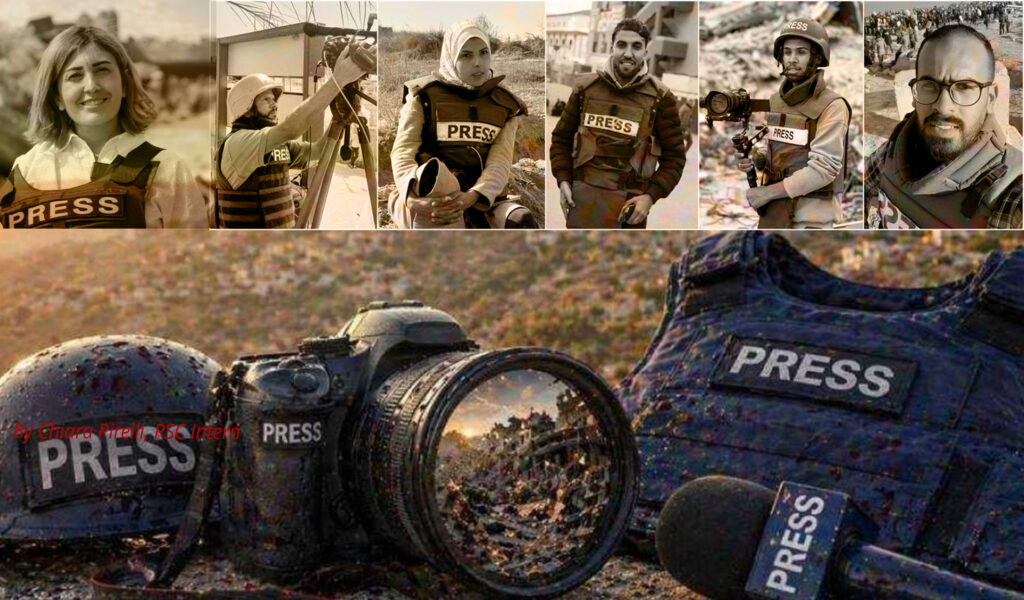
Khalil’s story is not an isolated incident. Across Southwest Asia, journalists operate under death-defying conditions, particularly in conflict zones shaped by political oppression. Collecting and sharing trustworthy information from Gaza, Syria, Lebanon, Yemen, and Sudan is becoming increasingly challenging and places lives of journalists in perilous situations.
Following World Press Freedom Day marked every year on May 3rd, it is crucial to recognize that press freedom has become a major victim of recent conflicts, with journalists increasingly targeted, particularly during the ongoing wars occurring in South West Asia. Beyond reporting, journalists there play a vital role in documenting human suffering, exposing rights violations, and safeguarding historical records against propaganda and chaos, acting as essential witnesses to the truth.
Press freedom carries both ethical and legal weight. At its core lies the moral principle that societies have the right to access the truth and hold those in power accountable for denying this access. International law enshrines this principle in Article 19 of the Universal Declaration of Human Rights, which states that “everyone has the right to freedom of opinion and expression” and to “seek, receive and impart information and ideas through any media and regardless of frontiers.” Art. 19 in the International Covenant on Civil and Political Rights (ICCPR) upholds the same principle and remind governments of their duty to protect journalists: “States parties should make every effort to ensure easy, prompt, effective and practical access to such information.” This is further reinforced by Article 79 of Additional Protocol I to the Geneva Conventions, which explicitly recognizes that journalists in armed conflicts must be treated as civilians, provided they take no direct part in hostilities. Consequently, deliberately targeting journalists, obstructing their work, or preventing medical teams from rescuing them may constitute a violation of the laws of war, actions that can be classified as war crimes, violating the fundamental requirement to treat civilians humanely and provide medical care to the wounded and sick without discrimination.
According to the latest World Trends Report (WTR) released by UNESCO, the Global Freedom of Expression Index has fallen by 10% since 2012. This decline marks a significant erosion of civil liberties not seen in decades, comparable to the levels recorded during the World Wars and the Cold War era. The reporting period (2022–2025) saw a 67% increase in journalist killings within conflict zones compared to the previous four-year period. This situation is particularly visible in conflict zones, where journalists are more likely to face imprisonment, displacement, and death.
Additionally, the Committee to Protect Journalists (CPJ) recorded 2025 as the year with the highest number of media workers’ fatalities, since data collection began in 1992. The CPJ also reported that most of these deaths occurred in Yemen, Iran, and especially in Gaza, making Southwest Asia one of the most dangerous warzones for journalists. In the Gaza Strip alone, over 260 journalists and media workers have been killed, since October 2023, according to Middle East Monitor (MEMO), and the International Federation of Journalists (IFJ). This is confirmed as the deadliest genocide for journalists.
While numbers are already sufficient to express the gravity of the situation, the following stories recall how urgent and critical the situation is. In October 2023, video journalist Issam Abdallah was targeted and killed by the Israeli army in southern Lebanon, after years of threats aimed at discouraging him from continuing his work. The same attack also injured six other journalists from various news outlets. Two months later, on December 15, Samer Abu Daqqa, a cameraman for Al Jazeera, was killed by an Israeli drone strike that targeted the school from where he was reporting, in Gaza. As for Khalil’s case, Israeli forces prevented rescuers from evacuating those under the rubble for hours.
This trend of attacks against press freedom was also observed in Syria. Since the start of the Syrian civil war in March 2011, according to the Syrian Network for Human Rights, approximately 717 journalists and media workers were assassinated, of whom 53 died under torture. Many others were kidnapped, detained, or disappeared by both state and non-state actors. This data underscores why organizations like Reporters Without Borders (RSF) and the Committee to Protect Journalists (CPJ) have consistently ranked Syria as one of the deadliest countries in the world for media professionals for over a decade. The situation was so dire that an article in the BBC in 2014 titled “Syria the most dangerous place in the world for journalists.”
However, threats to press freedom are not limited to physical harm. Censorship and threats, across Southwest Asia, can be seen in newspaper shutdowns and bans, as well as digital surveillance, internet restrictions, and regulatory pressure on independent media outlets. The recent Iran war, in March and April 2026, has triggered an escalation of the conflict in the Gulf region, where control over information has been considered a matter of national security. More than one hundred individuals have been arrested for filming missile interceptions and strikes and posting the footage online, under cybercrime legislation.
These statistics highlight a grim reality: journalists have transitioned from being observers of conflict to becoming direct targets and victims of it.
As the trend of constraint increases, many journalists continue their reporting in exile. Many reporters who used to work in conflict zones have established cross-border online platforms, networks, and diaspora media outlets to overcome domestic restrictions. Some examples are the Syrian Investigative Reporting for Accountability Journalism (SIRAJ), the Arab Reporters for Investigative Journalism (ARIJ), Daraj Media and Mada Masr. While the option of exile guarantees more safety for journalists, it also comes at the cost of distance from the sources, financial insecurity, and risk for family members who remain at home.
The suppression of press freedom triggers a domino effect that destabilizes entire societies. When independent reporting is hindered, the gap in the information is rapidly filled by misinformation campaigns, fake news, and propaganda, which distort public debate and erode trust in governing institutions. This breakdown in communication often leads to increased social polarization and heightened civil unrest, as citizens are deprived of verifiable facts. Especially in times of crisis, the role of an independent press represents a fundamental survival mechanism. Journalists serve as critical watchdogs, documenting rights abuses and preventing atrocities from being erased by official narratives. Because of this, press freedom must be recognized not just as a human right, but as a foundational pillar of stable governance. Without the transparency and accountability provided by a free media, the resilience of democratic and institutional structures inevitably begins to decay.
World Press Freedom Day serves as a critical reminder that the safety of journalists is inseparable from the public’s fundamental right to information. The staggering rise in journalist casualties across South West Asia proves that the adage “truth is the first casualty of war” is not just a metaphor, but a grim reality. This growing violence is both a human tragedy and a systemic warning: when journalists are silenced, the world loses its primary witnesses, leaving societies vulnerable to propaganda and the erosion of justice.
Ultimately, protecting press freedom requires more than just mourning those we have lost; it demands a relentless commitment to proactive advocacy and global support. Defending the rights of journalists and ensuring fair and universal access to information is far more than a legal precept.
It is a collective endeavor to uphold the principles of transparency and ensure justice for all. Safeguarding independent press in times of war is the only way to defend fundamental human rights and foster the resilience within society to sustain lasting peace and accountability.