Nearly 1,000 Voices Gather in Amman for a Public Dialogue on International Law, Corporate Responsibility, and Palestine
Anchoring Justice, Legal Evidence, Civic Mobilization, and the Future of Accountability
Discussing the Stories Behind the Reports and the Book When the World Sleeps: Lived Experience and Collective Memory
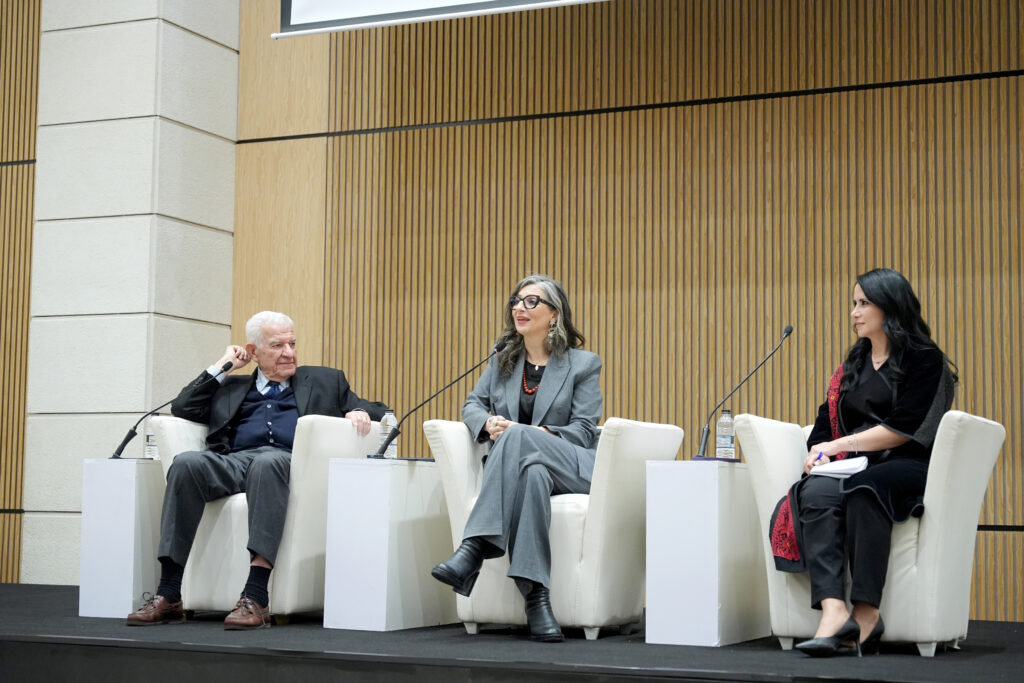
The Renaissance Strategic Center (RSC) at the Arab Renaissance for Democracy and Development (ARDD), convened “A Talk with Francesca Albanese,” United Nations Special Rapporteur on the situation of human rights in the Palestinian Territory occupied since 1967.
Held as part of RSC’s Question of Palestine Program, the event brought together nearly 1,000 participants, including Their Royal Highnesses Princess Basma bint Talal, Princess Ghaida, and Princess Dina Mired, alongside parliamentarians, senators, former ministers, diplomats, academics, civil society leaders, youth representatives, and members of the international community.
The dialogue featured international lawyer and Chief Editor of the Palestine Yearbook of International Law, Dr. Anis Kassim, and was moderated by Adv. Samar Muhareb, Executive Director of ARDD, presented by Adv. Mary Nazzal Batayneh, justice activist, barrister, and impact-driven entrepreneur.
Opening the evening, Adv. Mary Nazzal Batayneh emphasized the importance of translating legal analysis into collective action and public engagement: “This evening is about understanding the moment we are living in, and how principled legal work can be transformed into meaningful action toward accountability.”
Honoring Principled Leadership
Moderating the dialogue, Adv. Samar Muhareb underscored that the gathering was also intended as recognition of principled leadership within international human rights work:
“Tonight, we gather not only to listen, but to honor Francesca Albanese — a voice of courage and integrity whose work reminds us that international law must remain anchored in justice and human dignity.”
Muhareb reaffirmed ARDD’s commitment to sustaining inclusive spaces where legal scholarship, policy dialogue, and civic engagement intersect.
Shedding light on economic responsibility and contemporary conflict, Dr. Anis Kassim introduced Albanese’s latest report and reflected on the significance of her contribution to contemporary international legal discourse: “Francesca Albanese stands among the strongest contemporary defenders of dignity, peace, and justice. Her reports present rigorous legal analysis and documented facts that will remain essential to international accountability efforts.”
He emphasized the critical role of independent legal documentation in informing judicial processes and preserving the historical record.
Albanese’s report From Economy of Occupation to Economy of Genocide, examines the intersection between economic systems and situations of occupation and conflict, raising important discussions regarding corporate responsibility and international legal obligations.
Albanese noted that modern conflicts increasingly operate through interconnected global economic and technological structures, shaping realities far beyond traditional political arenas.
During her talk, Francesca Albanese reaffirmed the legal foundation of her UN mandate: “My role is to document and monitor violations of international law — no more and no less.”
Addressing regional concerns surrounding Israeli expansionist political narratives, she cautioned against interpreting developments solely through territorial frameworks: “If we see this only as territorial expansion, we misunderstand it. It is a project of domination that does not necessarily require boots on the ground.”
Her remarks situated the Palestinian question within broader transformations affecting governance, technology, and power relations within the contemporary international system.
The evening also marked the Jordan presentation of Albanese’s book When the World Sleeps, written alongside her UN reporting work. Moving beyond technical legal discourse, the book presents Palestine through encounters with individuals whose lived experiences illuminate the human realities behind legal terminology.
Reflecting on the book’s purpose, Albanese explained: “I wanted to tell how I came to understand Palestine, not only through law, but through people and their stories.”
Now translated into eighteen languages, the publication reflects growing international engagement with accessible approaches linking international law, lived experience, and collective memory.
The event concluded with a public book signing attended by participants from diplomatic, academic, and civil society communities.
At the conclusion of the discussion, H.R.H. Princess Basma bint Talal expressed appreciation to Ms. Albanese for her steadfast dedication to advancing international legal accountability and for amplifying principled voices working toward justice and human dignity.
ARDD also extends its sincere appreciation to the Government of Jordan for its continued support in enabling constructive dialogue and facilitating spaces that bring together international expertise, civil society, and public engagement around issues of regional and global importance. ARDD further extends its gratitude to the Landmark Hotel Amman, partners, and participants whose contributions enabled a meaningful and widely attended exchange.