Refugees are frequently spoken about through statistics, policies, humanitarian programs, and institutional assessments. Yet understanding displacement also requires listening to those living through it.
First-hand testimony can reveal what policies and humanitarian responses look like from the other side: the uncertainty surrounding a work permit, the difficulty of finding reliable information, the experience of unequal working conditions, or the hope of eventually returning home. Giving space to these voices is not simply about documenting individual stories; it allows refugees to articulate for themselves what matters, what is changing around them, and what they believe needs greater attention.
These reflections emerge within Jordan’s long-standing role as a major refugee-hosting country, at a time when refugees, host communities, humanitarian actors, and national institutions are all navigating increasing economic pressures and declining humanitarian resources.
The perspectives shared here reflect individual experiences and should not be understood as representative of all refugees or as institutional assessments of specific policies or actors.
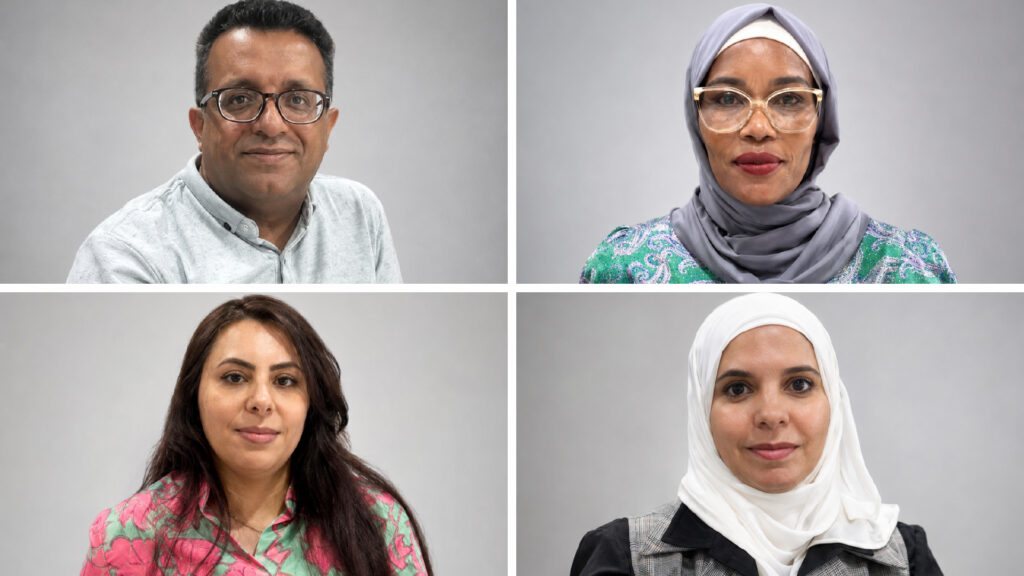
In conversations with Samia, Mohammed, Hadeer, and Bayan, four people with extensive experience within refugee communities and humanitarian work in Jordan speak about different aspects of displacement. Their testimonies do not present a single refugee experience. Instead, they offer four perspectives shaped by different backgrounds, concerns, and aspirations.
Samia: “No one chooses to become a refugee”
Samia, a Sudanese medical doctor, has extensive experience in refugee advocacy and humanitarian work. She volunteered with a UN Refugee Agency from 2009 to 2012 and served as a National Ambassador from 2012 to 2017, while also holding the role of Jordan Youth Ambassador. She has collaborated with ARDD since 2010 and worked with several other organizations supporting refugees and asylum seekers.
Her message begins with how refugees are perceived.
“No one chooses to become a refugee. We are human beings like everyone else, and all we ask is to be treated with dignity and respect.”
For Samia, refugees should be recognized as equals rather than looked down upon because of circumstances they did not choose.
She also describes insecurity surrounding work permits and protection. According to Samia, non-Syrian refugees who renounce their refugee status to obtain a work permit lose UNHCR protection and, if the permit is subsequently cancelled, may face risks of legal or residency consequences or deportation for working illegally. She says this leaves people fearful of losing both their legal status and the protection on which they depend.
Her own motivation comes from helping people who may have few other places to turn.
“Many refugees have no one abroad who can support them. When we can help, even in a small way, it reminds me why this work matters.”
She explains that many people simply want to feel heard and understood. For those without relatives or friends abroad able to provide financial assistance, even limited community support can make a meaningful difference.
Mohammed: The need for answers and a direct voice
Mohammed began volunteering in Jordan in 2015 and has supported refugees since 2016 through humanitarian organizations and his own community initiatives.
Asked what support refugees are missing, his response is stark:
“Everything. Everything has become non-existent.”
His answer reflects the severity with which he perceives the contraction of available support and opportunities. He points in particular to concerns around protection, education, psychosocial support, basic needs and access to livelihoods. He also raises concerns about age-related eligibility criteria that, in his experience, can limit access to certain livelihood or employment opportunities for refugees who remain willing and able to work.
A substantial part of his testimony, however, concerns information and communication.
He describes refugees approaching community volunteers with questions about their UNHCR registration and expecting answers or solutions. Volunteers often cannot provide them because they cannot speak for UNHCR or the government without first verifying the information. Mohammed also speaks candidly about the emotional burden this places on volunteers themselves.
During a recent meeting with UNHCR representatives, he says community volunteers sought further clarification on recent developments affecting work permits, eligibility, asylum documentation and the implications these may have for refugees. They also proposed additional opportunities for refugees to engage directly with UNHCR representatives.
For Mohammed, this direct contact matters.
“We hope our voices reach those who can unify the supporting efforts in general.”
He also notes the value donors increasingly place on hearing directly from refugees, alongside information provided through implementing organizations. His final message is similarly direct:
“We hope whoever reads this looks at us with a human eye. We hope that the refugee is seen not as a refugee, but as a human being, regardless of ethnicity, leanings, nationality or category.”
Hadeer: “To be able to go home”
Hadeer is Iraqi and has worked in the humanitarian sector since 2016, including with a Refugee INGO, supporting refugee communities through humanitarian programs.
Her testimony focuses on a specific barrier to self-reliance. Building on Mohammed’s concerns about age classifications, Hadeer similarly questions age-related eligibility criteria that she says can exclude some working-age refugees from particular opportunities, despite their willingness and ability to work and support their families.
She questions how people who are still capable of working and supporting their families can be excluded from opportunities to do so. In her view, such classifications create unnecessary barriers for refugees trying to become self-reliant and rebuild their lives.
When the conversation turns from immediate challenges to what she wants for the future, however, Hadeer needs only a few words:
“To be able to go home.”
Bayan: When access to work does not mean fair work
Bayan arrived in Jordan from Syria in 2014. Her humanitarian experience includes supporting unaccompanied and vulnerable children with another Refugee INGO and delivering life-skills and capacity-building programs for adults.
Her testimony turns the conversation toward the conditions refugees can face once they enter the labour market.
“There’s a lot of injustice toward refugee workers in general, and wages are pushed down.”
Bayan says refugees may not receive sick pay and can earn less than other employees performing the same work.
Bayan describes practices she has observed among some employers, including long working hours, wage deductions linked to sick leave, and differences in pay between refugee workers and Jordanians performing similar work. Her account highlights the gap that can arise between labor protections and workers’ experiences in practice.
“They are required to work excessively long hours, with Fridays often not recognized as a day off, and sick leave is effectively penalized.”
And when asked about her hopes for the future, Bayan’s answer is as straightforward as Hadeer’s:
“Going home, for sure.”
Listening to What Is Actually Being Said
These four testimonies bring different issues into view.
Samia speaks about being treated as an equal, the insecurity surrounding protection and work, and supporting people who have few alternatives. Mohammed emphasizes the lack of information and the need for refugees to communicate directly with those whose decisions affect them. Hadeer questions barriers that prevent people from working and becoming self-reliant. Bayan describes the unequal conditions refugee workers can encounter in the labor market.
And two of the shortest answers in these conversations are perhaps among the most telling. Asked about their hopes, Hadeer says, “To be able to go home.” Bayan says, “Going home, for sure.”
Across these conversations, Samia, Mohammed, Hadeer, and Bayan are clear about what matters: security and clarity about their future, fair opportunities to work and support themselves and their families, equal treatment, and a direct say in decisions that affect them. They also speak of solidarity, contribution, and, for some, the enduring wish to return home. Their experiences bring knowledge that should inform how policies and responses are shaped, and how a more just future is imagined.
Responding to these priorities requires different stakeholders to play their part, from governments and UN agencies to donors, employers, humanitarian organizations, and civil society. But it also requires engaging refugees directly in those conversations. Samia, Mohammed, Hadeer, and Bayan are not only describing challenges; their experiences offer knowledge about what needs attention and what can change.