Times of War: Regional Policy Dialogue Series
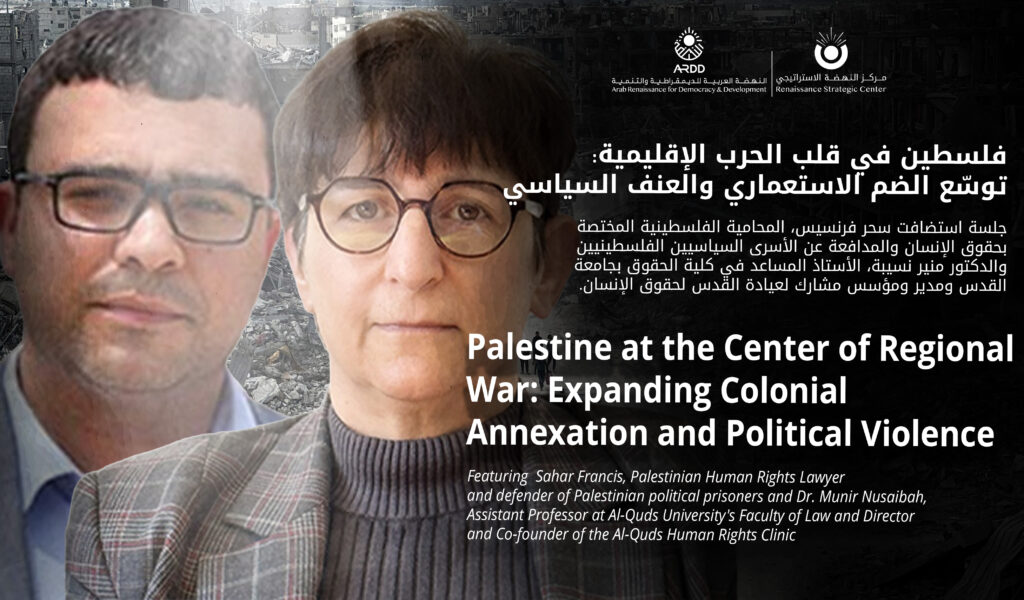
Featuring Sahar Francis, Palestinian Human Rights Lawyer and defender of Palestinian political prisoners for over 25 years, and Dr. Munir Nusaibah, Assistant Professor at Al-Quds University’s Faculty of Law and Director and Co-founder of the Al-Quds Human Rights Clinic
Overview
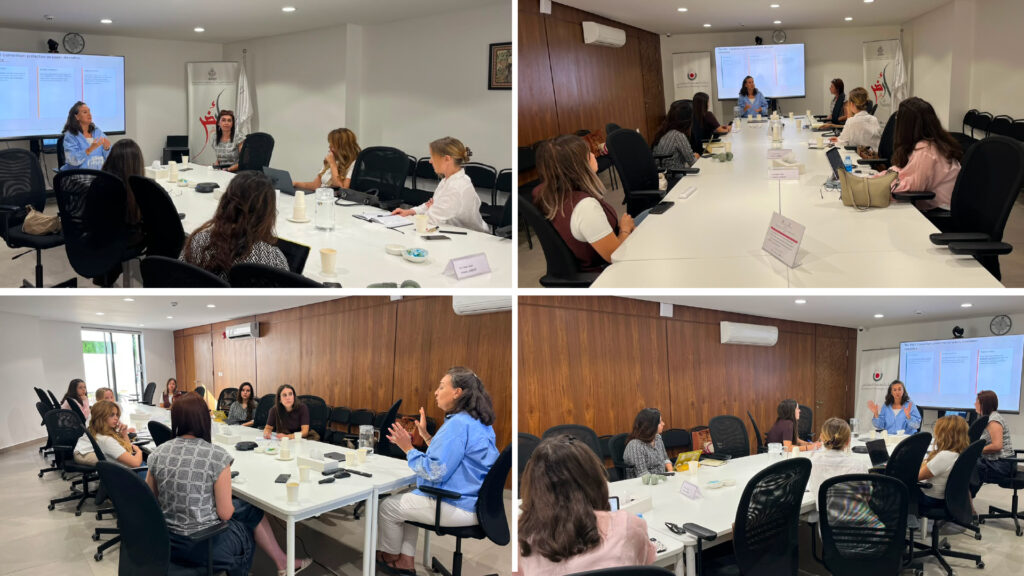
The Middle East faces a dangerous escalation of conflict rooted in long-standing, unresolved structural issues like colonial legacies and the unresolved question of Palestine. In response, the Renaissance Strategic Center (RSC) convened an online policy dialogue on April 27, 2026, as part of the Times of War: Regional Policy Dialogue Series. This session focused on “Palestine at the Center of Regional War: Expanding Colonial Annexation and Political Violence.”
The webinar examined how current forms of colonial violence in Palestine, including accelerating land annexation in the West Bank, the formalized death penalty of prisoners, and broader forms of political repression, are shaping and being shaped by the wider regional war. It explored how Palestine remains central to understanding the current regional crisis and its future trajectories.
Invited panellists, Sahar Francis, Palestinian Human Rights Lawyer and defender of Palestinian political prisoners for over 25 years, and Dr. Munir Nusaibah, Assistant Professor at Al-Quds University’s Faculty of Law and Director and Co-founder of the Al-Quds Human Rights Clinic, provided an in-depth analysis on how the death penalty law, the tratement and abuse toward Palestianian prisoners, the acceleration of land annexation and political repression in the West Bank, all constitute a central element to understand the actual dinamycs behind the current regional war.
The discussion was moderated by Dr. Mariam Abu Samra, Head of the Renaissance Strategic Center at ARDD.
Palestine at the Center of Regional War
Dr. Mariam Abu Samra began the session by emphasizing that Palestine is part of a colonial logic and project, which extends beyond its immediate geography. Structures of displacement, territorial expansion, and violence define not only Palestine, but the broader region as well. Palestine is both central to and affected by the current regional war.
The Treatment of Palestinian Prisoners
Sahar Francis explained that the escalation in the abuse of Palestinian prisoners is a structural component of an illegal settler-colonial project, sustained by a normalized, discriminatory dual legal system and by international inaction. The weaponization by Israel of legal instruments is integral to the context of the normalization of violence historically implemented by Israel, including the legalization of the death penalty by its judicial system.
This system relies on British Emergency Regulations and the 2016 “Anti-Terror Law,” culminating in the March 30, 2026, passage of a death penalty law that removes key judicial safeguards, resulting in a system described by experts as fundamentally unreformable and in need of dismantling. The Israeli military legal system in the occupied territories systematically bypasses international humanitarian law by applying draconian 1945 British emergency regulations that prioritize secrecy over fair trial standards. Although the death penalty was already part of the Israeli military legal system, the decision had to be taken by consensus, and the military authority had the capacity to grant amnesty and to commute the sentence. The March 30, 2026, amendment to the Death Penalty for Terrorists Law further removes key judicial safeguards, establishing a discriminatory legal framework that targets just Palestinians as such. It is a discriminatory law that reflects the legal apartheid system; military laws in occupied territories are just against the Palestinian people, and not against settlers.
According to international humanitarian law, new legislation by an occupier must take into consideration the protection of the interests of the people under occupation; the death penalty does not respect this. International human rights organizations and several special rapporteurs have written about these critical aspects in the Israeli military court system, and the latest report by Francesca Albanese, the UN Special Rapporteur on the situation of human rights in the Palestinian territories, emphasized with even greater clarity that there is no way to amend this system; it must be dismantled, as it is a grave violation of international law.
The Abuse of Palestinian Prisoners
Conditions in Israeli detention centers have deteriorated sharply since October 7, 2023, with reports of widespread, systematic torture and brutality against over 30,000 Palestinian detainees arrested since October 7. Documentation suggests these actions, which have resulted in numerous inmate deaths, constitute a systematic policy rather than isolated incidents, resulting in the death of many prisoners.
The rights of prisoners are being abused to an unprecedented level by deliberate medical neglect, intentional starvation, and the cutting of essential resources like water and electricity. Prisoner rooms are raided daily, and families and the Red Cross have been prohibited from visits. Reports indicate that over 89 detainees, including a child, have died amidst a widespread, untreated scabies outbreak caused by severe hygiene deficiencies and total isolation from the outside world. There have been reports of extended periods of interrogation and detainment without charge or trial, with some detainees enduring more than two years in administrative detention, including children. The total number of detained children is currently 350, with a total of 10,000 Palestinians currently in detention.
More than 700 bodies of those who died in detention have been held by Israeli authorities, some from decades ago. This amounts to collective punishment against the families of the deceased.
The Broader Context
It is important to consider the abuses of Palestinian prisoners in the broader context of the Israeli regime, which systematically applies apartheid, genocide, and abuse of the Palestinian people. All these violent actions have worsened since October 7. Furthermore, the parliament’s approval of the Death Penalty Law, following years of political opposition in Israel, highlights a prevailing sense of impunity. Consequently, it’s not surprising to witness a simultaneous rise in the torture and mistreatment of Palestinian prisoners. Efforts to normalize the violent suppression of Palestinians are part of a larger agenda. This situation serves in fact as a critical test: if the international community permits these new standards to take root, it could signify the termination of international law. A structural analysis of these issues is thus essential.
De Facto Annexation of Palestinian Land by Israel
Dr. Munir Nusaibah highlighted Israel’s efforts to legitimize the de facto annexation process through a legal framework that facilitates ongoing and accelerated displacement in the occupied Palestinian territories.
The Nakba offers crucial context. Under the shadow of war, Israel succeeded in displacing 80% of the Palestinian population, creating the Palestinian refugee crisis. This was accomplished through military operations involving both official forces and smaller militias. Presently, again amid the genocide in Gaza, aggression in Iran and Lebanon, and the distraction of the media from Palestine, again we are witnessing a significant push towards Israel’s colonial ambitions. The number of colonial settlements has surged, along with the development of civil infrastructure like roads with barriers; nearly every village and city in the West Bank is now gated. Colonial graffiti proclaiming “No future in Palestine” captures the sentiment.
The issue of annexation, claiming land, integrating a domestic legal system, and maintaining military control, has long been a clear objective of Israel. For instance, one justification for the Israel-UAE “peace agreement” was that it encouraged Israel to forgo annexation. However, what is unfolding on the ground amounts to the practical execution of annexation, occurring without any formal announcement. Various mechanisms are being employed to achieve de facto annexation.
The Israeli Legal System as a Tool for Annexation
The Israeli legal system serves as a key instrument that reinforces the apartheid regime and shapes its functioning. State institutions are actively developing mechanisms to implement de facto annexation; for instance, new legislation has been introduced to extend Israeli civilian enforcement into Areas A and B, including regions controlled by the Palestinian Authority. Existing laws and legal frameworks have also been exploited to facilitate displacement.
In Jerusalem, homes lacking permits are being demolished, with authorities refusing to issue permits to Palestinians. In the West Bank, vast areas are being designated as “state lands,” making them available for colonial settlement and construction while rendering them unusable for Palestinians. In Area C of the West Bank, the Israeli government and security cabinet have initiated a land registration process to document land rights and real estate titles. This process completely bypasses the Palestinian Authority, further entrenching the Israeli appropriation of land for its colonial agenda.
Other Methods of Displacement and Dispossession
Organized military operations have led to the displacement of several civilian refugee camps in the northern West Bank and the Jordan Valley. In Gaza, a strategy of destruction has been employed, with over 90% of homes and infrastructure obliterated, leaving approximately 55% of the Gaza Strip under Israeli military control. This devastation extends to agricultural infrastructure, severely undermining Palestinians’ ability to earn a livelihood and produce their own food.
Patterns of “Settler Violence” or Colonial Terrorism
The phenomenon of “settler violence,” or colonial terrorism, is another critical aspect to consider. In recent years, Israel has been arming individuals and issuing licenses to civilians for carrying weapons. Settlers have organized militias that roam Palestinian villages, attacking homes and farms, not just during olive harvest season, but daily. This has, in some instances, resulted in the complete depopulation or cleansing of entire villages. While these militias are not officially recognized as state institutions, the state has facilitated their actions and granted them impunity, with some attacks even occurring in the presence of military personnel.
These mechanisms are aimed at altering territorial demographics and forcibly removing Palestinians from their homes and land. The Israeli apartheid regime is engendering a new wave of the Nakba, with civilian populations bearing the brunt of this violence. The international legal system has proven inadequate and unwilling to offer the necessary protection for the Palestinian people.
To this point, Dr. Abu Samra added that the ongoing manifestations of various forms of oppression reveal a pattern of colonial violence that continues to evolve. Equally, the steadfast resistance of the Palestinian people against this violence demonstrates their resilience.
The Extension of Violence into the Broader Region
The discussion underscored the importance of placing Palestine at the center of discussions regarding the spread of violence in the broader region. Both speakers noted that similar violations occurring in Palestine are now happening in Lebanon and Syria as well. Ethnic cleansing tactics are being employed to clear those lands for colonization.
Regarding prisoners, daily arrests and incarcerations of prisoners are ongoing, with little accountability for violations committed against them. The colonial project in Palestine persists, further complicated by financial and violent assaults on humanitarian organizations like UNRWA, which hinder efforts to document crimes and abuses. This situation poses a threat not only to the Palestinian human rights community but also to the international human rights framework.
Dr Abu Samra finally pointed out that the current violence and brutality of the colonial project reveal a system struggling to maintain itself, in the face of growing recognition that such injustice is unsustainable. Globally, there is an increasing acknowledgment of the colonial nature of this violence, the project itself, and the broader system it represents.
The Dialogue Continues
The Times of War: Regional Policy Dialogue Series will continue to explore these dynamics in the sessions ahead. Subsequent sessions will bring together additional expert voices and guest speakers to offer their perspectives on the evolving crisis, examining its humanitarian consequences, economic ramifications, and the prospects for regional and international diplomacy. Together, these sessions aim to build a more comprehensive and grounded understanding of what this conflict means for the Middle East and for the world.