Times of War: Regional Policy Dialogue Series – Session Summary
Overview
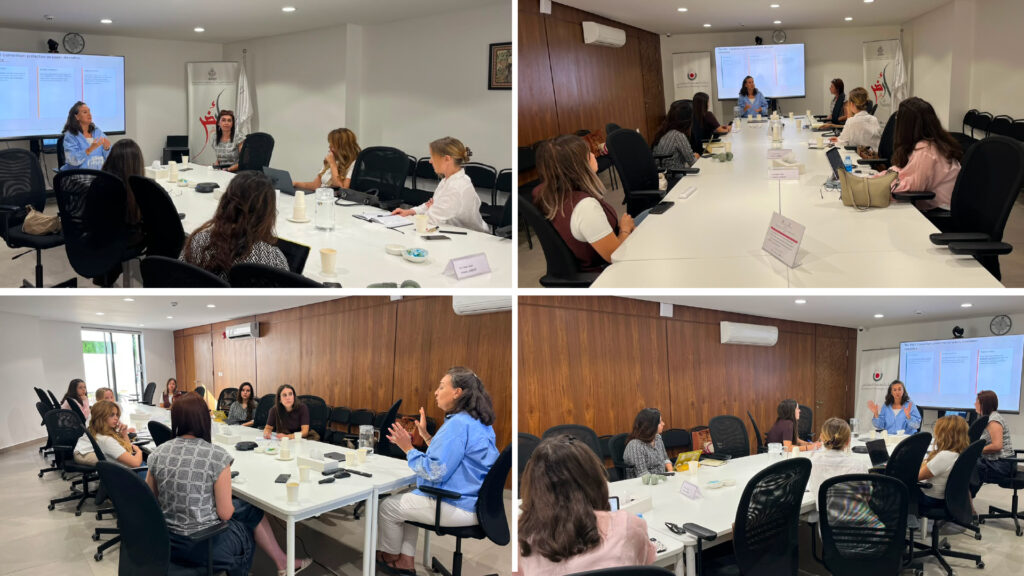
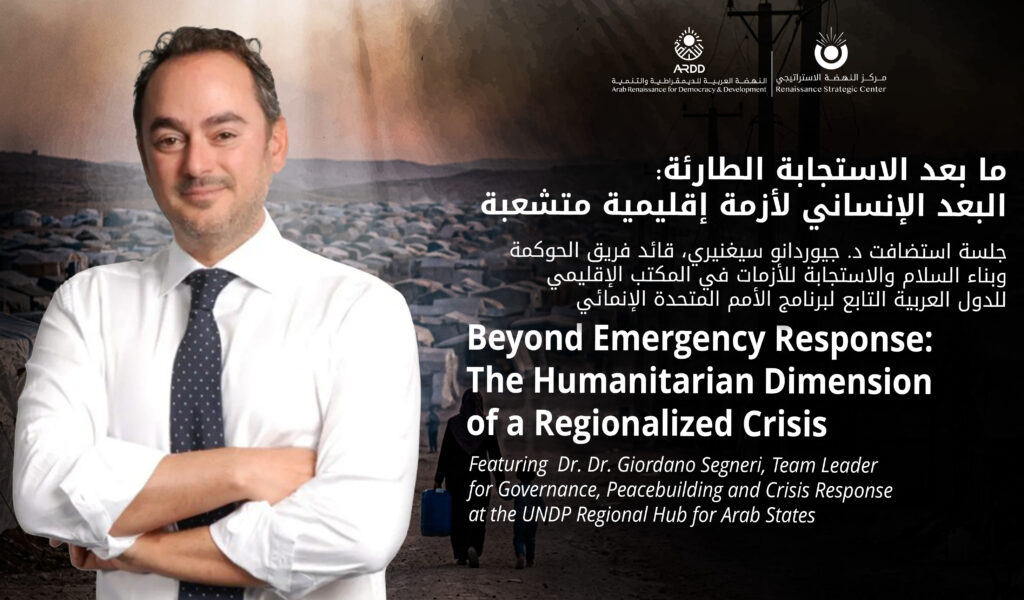
As the humanitarian consequences of the regional crisis continue to deepen, the Renaissance Strategic Center (RSC) convened, on May 3rd, 2026, the fourth webinar of its ongoing Times of War: Regional Policy Dialogue Series. The session, entitled “Beyond Emergency Response: The Humanitarian Dimension of a Regionalized Crisis,” examined the role of humanitarian and development actors in responding to an increasingly protracted and regionalized conflict landscape.
The webinar explored the structural limitations of emergency-only responses, the mounting challenges facing the humanitarian sector from funding shortfalls and operational access constraints, stressing that early recovery must happen alongside humanitarian relief, with prevention serving as an always-on priority.
The invited speaker, Dr. Giordano Segneri, Team Leader for Governance, Peacebuilding and Crisis Response at the UNDP Regional Hub for Arab States, offered an in-depth analysis drawing on UNDP’s operational experience across Syria, Yemen, Gaza, Iraq, Sudan, and Somalia. He argued that humanitarian and development challenges are increasingly intertwined, and where de-escalation and humanitarian access are urgent and non-negotiable, they must be matched simultaneously by early recovery efforts. This integrated approach is essential to reduce the humanitarian caseload, rebuild local capacities, and progressively transition affected populations away from long-term aid dependency toward sustainable self-reliance.
The discussion was moderated by Dr. Mariam Abu Samra, Head of the Renaissance Strategic Center at ARDD.
The Evolving Nature of Crisis in the Arab States
Dr. Segneri opened the fourth session of the Times of War Series by situating the current humanitarian landscape within a broader structural analysis. Crises in the Arab region, he argued, are no longer disconnected shocks but increasingly protracted, compounded, and interconnected. Conflict dynamics are shaped by overlapping factors: social and political tensions, displacement, environmental pressures, and water scarcity. Fragmentation of governance further complicates humanitarian reach and recovery.
The spillover effects are equally significant; instability in one country fuels displacement, economic stress, and insecurity across borders, affecting even relatively stable states. The recent military escalation between Iran, Israel, and the United States illustrated this dynamic starkly: within the first four weeks of the regional escalation, UNDP estimated a GDP contraction of 3.7 to six percent regionally and a rise in unemployment affecting 3.6 million people, with up to four million additional individuals at risk of sliding into poverty. Lebanon alone saw over one million people displaced, alongside 250,000 Syrian refugees moving back and 50,000 Lebanese crossing into Syria.
Funding gaps compound the crisis. The Syria Regional Refugee and Resilience Plan (3RP), co-led by UNDP and UNHCR, was funded at only 26 percent in 2025 – the lowest level since the plan’s inception, while major Arab crises remain severely underfunded, with some responses at just 20 percent last year. Trade route disruptions, rising energy prices, and fuel inflation have further eroded the region’s economic situation, where many governments face budgetary constraints in their efforts to maintain services and meet the costs to cope and respond to crisis.
The Challenges Facing the Humanitarian Sector
Operational Access and the Politicization of Aid
Humanitarian access remains severely limited across multiple crisis contexts. In Gaza, the operational environment remains restricted, and in places like Sudan, Syria, and Yemen, insecurity, bureaucratic impediments, and fragmented territorial control continue to undermine the predictability and reach of aid delivery.
The politicization of aid adds a further layer of complexity. Parallel governance structures and the influence of non-state armed groups as de facto service providers, increase the risk of aid diversion, compromise staff security, and raise difficult questions about engagement and legitimacy.
Funding Architecture and Systemic Gaps
The current donor-funding model, Dr. Segneri argued, is not equipped to address protracted crises, where critical investments in early recovery, such as restoration of livelihoods, economic connectivity, restoration or repair of critical infrastructures, maintenance of basic services, and preventing municipal capacities from further erosion or collapse are often de-prioritized. This creates a self-reinforcing cycle: without early recovery, humanitarian caseloads stagnate or expand; without flexible, multi-year financing, agencies cannot plan or invest with the necessary time horizon that enables continuity beyond the emergency phase.
In the current funding landscape, it is also paramount to diversify financing mechanisms, including through blended finance instruments, concessional loans, engagement with philanthropic actors, and explore insurance instruments increasingly used in disaster-prone settings. He noted the importance of developing internal institutional capacity to engage with such innovative financing approaches.
As a practical way to accelerate recovery, he pointed to the need to engage more with the private sector, as even in a crisis, communities reconnect with markets. He advocated for a three-track approach (short, medium, longer term) to accompany the transition from emergency employment to sustainable livelihoods, requiring routine assessments to value chains, promotion of financial inclusion, and private sector strengthening. He also stressed the importance of engaging non-traditional partners, including Chambers of Commerce, Manufacturing and Industrial Bodies, as actors capable of contributing meaningfully to crisis recovery.
The Case for Early Recovery
The central argument of Dr. Segneri’s presentation was a strong call to consider early recovery as an integral component of humanitarian response – not a sequel to it. He invoked UNDP Administrator Alexander De Croo, framing: “We cannot afford to wait for the dust to settle. We must bridge the gap between emergency relief and sustainable recovery from day one.”
Early recovery investments, he argued, yield immediate and compounding benefits. They restore livelihoods and agricultural systems by repairing irrigation infrastructure. They enable municipalities to resume essential functions such as solid waste management, provision of documentation services; and fixing electricity, sewage or water systems. They provide communities with a sense of purpose and agency, reducing dependency on aid over time.
Dr. Segneri drew on UNDP’s work in Gaza as a concrete example: 600,000 tons of solid waste collected by 16 trucks and a 50 fleet vehicle; over 280,000 tons of debris cleared; a third of that rubble crushed and reused; and support to small businesses at the base of productive value chains.
In Syria, it has become clear that context-sensitive area-based programming, carried out as part of local recovery, developed in consultation with local authorities, civil society and the affected population, can help building community resilience, fostering self-reliance, and creating conditions that facilitate refugees’ return.
In Iraq, UNDP implemented a flagship model for early recovery and stabilization. The establishment of the Funding Facility for Stabilization, a decade-long, $1.5 billion initiative supported by over 30 donors, has facilitated the recovery of ISIL-liberated areas and the return of five million displaced people. This was achieved by combining rapid and at-scale delivery with robust government partnerships to achieve priorities, identified jointly with local actors.
He advocated for early recovery, which has to be embraced as a legitimate and necessary complement to humanitarian response, not a deviation from mandate. Keeping development actors out of crisis settings is, he argued, simply costly; it will leave structural vulnerability unaddressed, accelerate institutional decline; it will erode resilience, and increase the risk of setbacks.
The HDP Nexus and the Importance of Local Ownership
Dr. Segneri emphasized the importance of the ‘Humanitarian-Development-Peace’ (HDP) nexus as a framework for ensuring that emergency relief is linked to longer-term recovery, reconstruction processes, and peaceful solutions. The HDP Nexus is not about merging funds or mandates but making sure the design of interventions have this continuum in mind. There is no sequencing, but rather an integrated vision where humanitarian assistance reinforces development pathways, laying the foundation for peaceful trajectories.
Local ownership emerged as a recurring theme. External aid is inherently temporary, and sustainable recovery is only possible when local institutions and communities are empowered to lead and maintain the response long after international support phases out. Also, preserving planning, engineering, and service delivery capacities avoids parallel systems, avoid vacuum non-state armed groups to exploit. On the other hand, civil society organizations should not be seen merely as implementing partners, but as actors in their own right, with their own recovery needs, including mental health and psychosocial support for staff who have experienced the same trauma as the populations they serve.
Local engagement must be grounded in conflict sensitivity and robust mechanisms for due diligence and risk management. Crucially, localization must not become an exercise in mere risk transfer, where local actors disproportionately shoulder security and operational burdens. Instead, it requires a commitment to equitable risk-sharing, ensuring local partners are supported and resourced to navigate these complex environments.
Prevention as a Strategic Investment
Finally, conflict prevention is both a moral imperative and an economic argument. Dr. Segneri mentioned a 2018 UN-World Bank report, “Pathways to Peace” estimating that every dollar invested in prevention can save up to sixteen dollars in conflict and crisis response costs. A recent IMF study, utilizing advanced economic modeling, estimates that every dollar invested in prevention yields a return of between $26 and $103 in avoided GDP losses, humanitarian costs and security expenditures.
UNDP prevents conflict in different ways, such as by promoting inclusive dialogue, supporting infrastructures for peace, setting up early warning and early response systems, and empowering local communities to lead their own mediation efforts. For example, UNDP has established and supported insider mediation networks across Jordan, Lebanon, Sudan, Yemen, and Somalia. These networks, encompassing trusted local actors such as teachers, doctors, youth, local authorities, and traditional leaders, are equipped to intervene early and resolve local disputes, both offline and online, when fueled by misinformation and disinformation. Similarly, in Gaza, Syria, and other places, UNDP supports Alternative Dispute Resolution (ADR) mechanisms. By engaging lawyers, community leaders, civil society and women groups, these initiatives effectively manage tensions related to issues such as family disputes, displacement-related conflicts, tensions around housing, land, and property (HLP), etc.
Dr. Segneri discussed the structural constraints on conflict prevention and resolution, pointing to the challenges posed by the current global political landscape, reflected also in the effectiveness of traditional international mechanisms, and emphasized the importance of regional actors and architectures in driving mediation, noting that this potential should be actively supported.
Parallelly, Dr. Segneri addressed the destabilizing impact of AI and emerging technologies in conflict dynamics and warfare. He cautioned against the use of algorithmic tools for information manipulation, underscoring the urgent need for robust international governance to manage these modern digital threats to peace and security.
Maintaining Neutrality in a Politicized Environment
Replying to the question about how to maintain operational neutrality in highly contested environments, Dr. Segneri emphasized commitment to ensure assistance based on humanity, impartiality, neutrality, and independence. The approach of development actors should contribute to social cohesion, maximizing the positive impact of humanitarian assistance.
Dr. Segneri asserted that conflict-sensitive programming should be integrated into all development interventions, not simply as a compliance obligation, but as a means to enhance peace outcomes. Even a technical project to restore an electricity grid can be designed in ways that either build community cohesion or exacerbate tensions over who benefits from it and who does not. UNDP’s most effective role is within local communities, where it can build resilience by strengthening social cohesion and reducing internal tensions. Ultimately, this localized resilience and grassroots trust serve as the indispensable foundation for broader, national-level peace and stability.
One Critical Shift: Investing in Early Recovery from Day One
Asked to identify the single most important shift the humanitarian sector must make in the next five years, Dr. Segneri returned to his central argument and the recognition that early recovery is not a post-emergency process but a core component of humanitarian response. Funding it early and consistently would shorten humanitarian timelines, reduce caseloads, prevent institutional collapse, and begin to build the social and economic fabric from which sustainable recovery can develop.
Dr. Segneri pointed out that, despite the challenges faced along the way, the ongoing “Humanitarian Reset” is a valuable process aimed at making the system faster, lighter, and more accountable. It is also encouraging as it embeds transition planning from day one and acknowledges that humanitarian aid alone cannot solve protracted crises, calling for development donors and agencies to step in earlier to build long-term resilience, rather than waiting for a “post-conflict” phase that may never arrive.
The Dialogue Continues
The Times of War: Regional Policy Dialogue Series will continue to examine the evolving dimensions of the regional crisis in the sessions ahead. Subsequent webinars will bring together additional expert voices to explore the political, economic, and diplomatic dimensions of the conflict, building toward a more comprehensive and grounded understanding of what this moment means for the Arab region and for the international order.