Livelihoods are central to strengthening resilience, reducing vulnerability, and expanding economic opportunities for refugees and host communities in Jordan. Yet sustainable impact depends not only on what programs deliver, but also on who sets priorities, controls resources, and participates in decision-making.
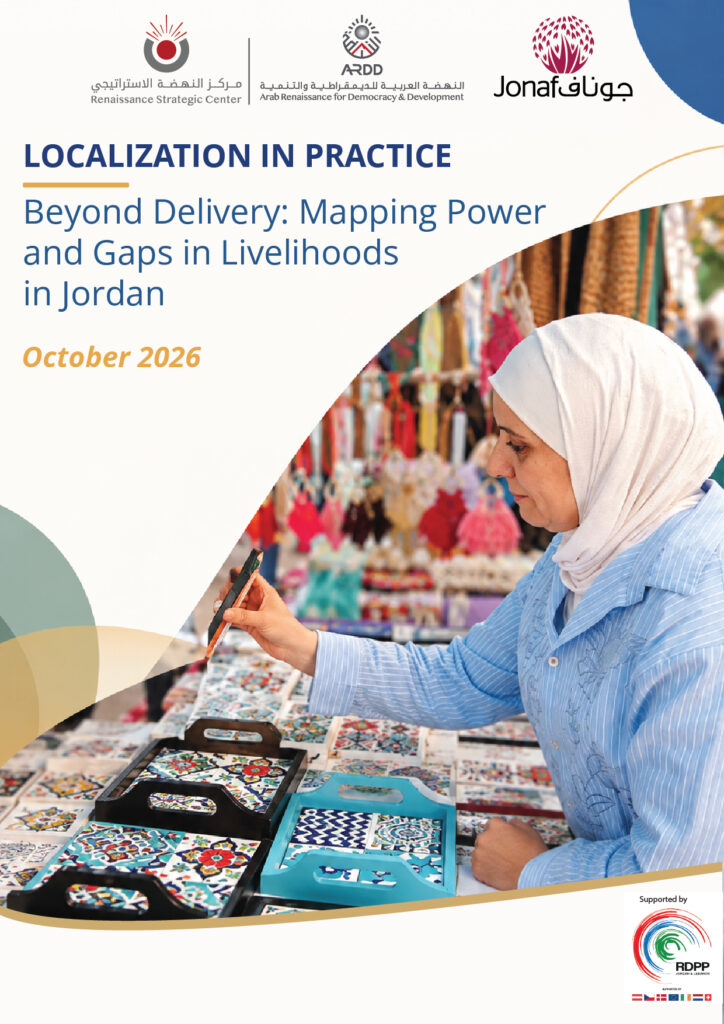
This report provides a comprehensive analysis of Jordan’s livelihoods landscape through the lens of localization of humanitarian action. Drawing on a mapping of 108 livelihood and economic empowerment initiatives across Jordan’s 12 governorates between 2020 and 2030, it examines who is being reached, where investments are concentrated, which forms of support are prioritized, and how partnerships between international, national, and local actors are structured. RDPP Localization of Livelihood…
The findings reveal persistent gaps in geographic coverage, inclusion, access to direct funding, and local participation in strategic decision-making. They also show that local and national organizations are too often positioned primarily as implementers rather than as equal partners in program design, financing, and governance.
The report therefore calls for a shift from localization in principle to localization in practice. Its recommendations emphasize stronger local leadership, greater access to direct and flexible funding, meaningful participation in decision-making, more equitable partnerships, and longer-term approaches to capacity strengthening and sustainability. These measures are essential to making livelihood programmes more inclusive, locally grounded, and capable of contributing to lasting resilience and development in Jordan.
This document has been produced with the financial assistance of the European Regional Development and Protection Programme for Jordan and Lebanon (RDPP III), a joint European initiative supported by Austria, the Czech Republic, Denmark, the European Union, Ireland, the Netherlands, and Switzerland. The content is the sole responsibility of the Arab Renaissance for Democracy and Development (ARDD) and can under no circumstances be regarded as reflecting the position of RDPP III or its donors.