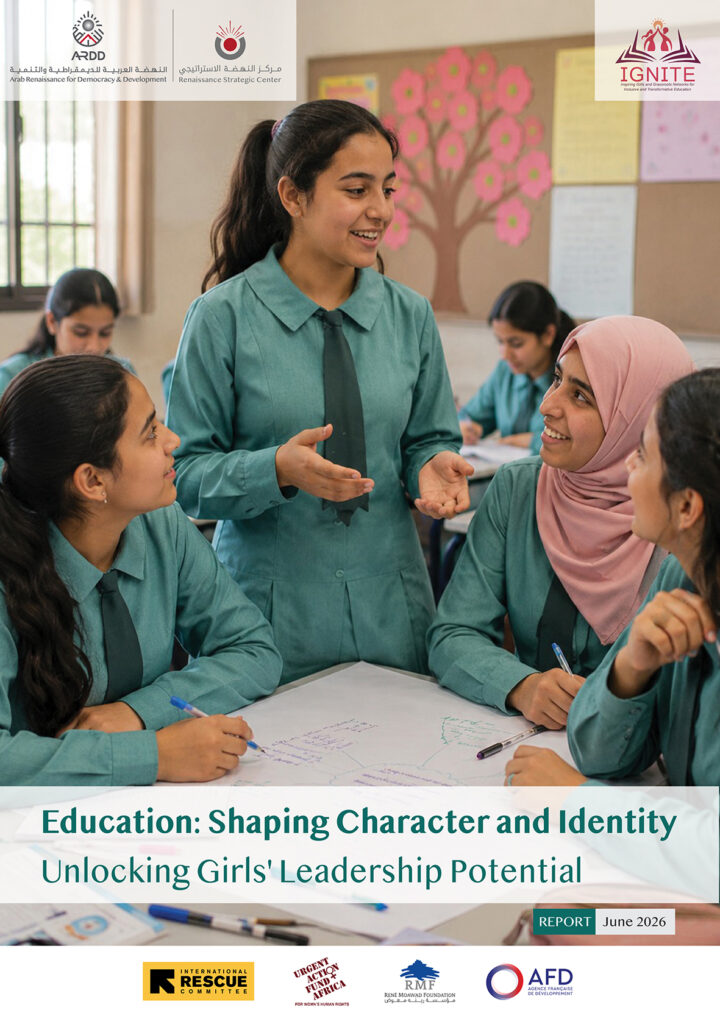
Jordan has made significant progress in girls’ education. Girls consistently outperform boys in literacy, school
completion, and academic achievement, and the country has achieved near-universal enrollment in basic education.
Yet these educational gains have not translated into equal participation in public life. Women remain underrepresented
in politics, leadership positions, and the labor market, where female participation has remained between
13–15% in recent years. This raises a critical question: why does educational success not translate into
leadership, agency, and participation for girls and young women?
This report examines how teachers, school environments, curricula, extracurricular activities, and family engagement
shape leadership opportunities for girls and young women in Jordan. Drawing on mixed-methods research
conducted in public schools in Amman and Mafraq, the study explores both the role teachers play in encouraging
leadership and the broader structural barriers that limit these efforts.
The findings show that teachers play a significant role in fostering confidence, participation, responsibility, and
public speaking skills among students, particularly girls. Many teachers use active learning methods and classroom
responsibilities, such as the “little teacher” approach, to encourage leadership and participation. However, these
efforts are constrained by overcrowded classrooms, administrative burdens, limited resources, and the pressure of
the Tawjihi examination system, which prioritizes memorization and curriculum completion over creativity, participation,
and skill development.
The research also demonstrates that gendered expectations continue to shape classroom interactions and perceptions
of leadership. Girls are often associated with modesty, obedience, and emotional sensitivity, while boys are
linked to assertiveness and authority. Although many teachers actively encourage girls’ participation, these broader
stereotypes continue to influence how leadership is understood and practiced within schools.
The curriculum itself remains limited in its ability to cultivate leadership skills. Teachers and students alike described
the curriculum as overly exam-oriented and lacking strong, culturally relevant female role models. Leadership
development therefore depends largely on individual teachers rather than systematic educational approaches.
At the same time, important disparities exist between schools and regions. Students in underserved areas,
particularly in Mafraq, face limited access to libraries, theaters, extracurricular activities, and psychosocial support
services, restricting opportunities for participation and self-development.
The report further highlights the importance of family engagement. Previous and current findings show weak and
inconsistent communication between schools and families, particularly beyond the early years of schooling. In
many cases, teachers are left to negotiate individually with parents to secure girls’ participation in activities and
leadership opportunities.
The report argues that strengthening girls’ leadership requires moving beyond narrow understandings of academic
achievement toward a broader vision of education as a space for shaping character, confidence, participation, and
social responsibility. Supporting girls’ leadership cannot depend on teachers alone. It requires investment in the
wider educational environment, including curriculum reform, psychosocial support services, extracurricular activities,
equitable resource distribution, and stronger parent-school partnerships.
Key recommendations include reducing administrative burdens on teachers, reforming aspects of the Tawjihi system,
expanding gender-responsive teacher training, increasing the representation of women in school curricula,
investing in extracurricular and leadership programs, strengthening psychosocial support services, and improving
communication between schools and families.
Ultimately, the gap between girls’ academic success and their underrepresentation in public life is not merely an
educational issue, but a broader societal challenge. Without addressing the structural conditions that limit girls’
opportunities to develop confidence and leadership, the education system risks losing the potential of an entire
generation of young women.
Publications